AI & Autonomy 101 · Reality is the special effect

The world is coming alive.

Things that think.Things that move.Things that act.

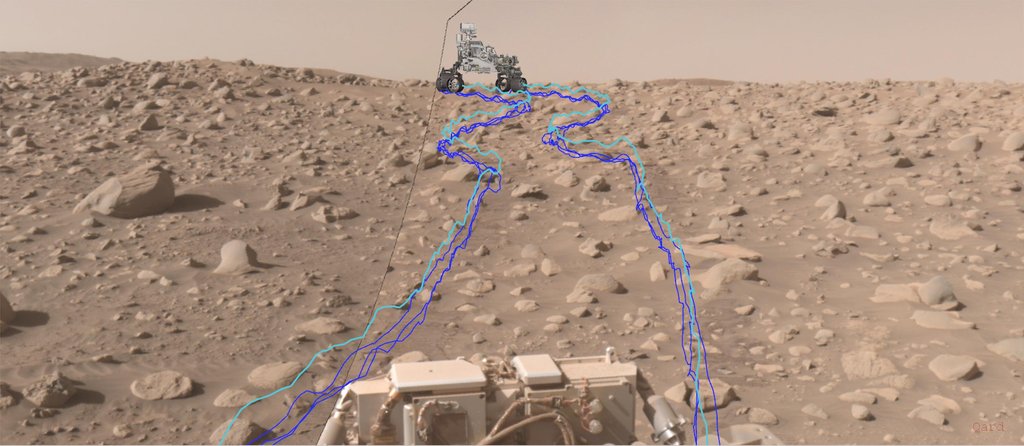
A rock-strewn Martian slope photographed by Perseverance's navigation camera. JPL added a computer model of the rover and winding blue lines that trace the path its wheels took around the boulders.Annotated compositeCourtesy NASA/JPL-Caltech · PIA26071

A real photo from Perseverance's navigation camera, June 29, 2023. JPL added the rover model and the recorded tracks of its six wheels. It is a still image, not a video or a live view. Follow the tracks up to the rover.

Right now, on Mars

A rover is choosing its own path.

NASA's Perseverance can't be steered with a joystick: a radio signal takes many minutes to reach Mars. So people on Earth choose where it should go, and its AutoNav system works out how to get there, mapping the rocks ahead and steering around them while it drives.

  • 28.10 mileson the odometer, Oct. 11, 2026: the farthest any vehicle has driven on another world
  • 90%+of that distance driven using AutoNav
Learn how it works

Facts reported by NASA's Jet Propulsion Laboratory, Oct. 12, 2026. ItsAlive.ai is independent; nothing here implies NASA endorsement.

From the drive logs

The Snowdrift Peak boulder field, 2023. How far the rover had to go, and how far it actually drove:

1,706 ftPlanned: a straight line across, including two stops at boulders the science team wanted to inspect
2,490 ftDriven: AutoNav steering around rocks the orbital maps didn't show
JPL, Sept. 21, 2023NASA Jet Propulsion Laboratory · 2023-09-21
  1. Lands in Jezero Crater on Mars.
  2. The picture above: weaving through a dense boulder field.
  3. Passes 28.10 miles (45.22 km), the farthest any vehicle has driven on another world.

The evidence

What you're seeing

The picture

A real photo from Perseverance's navigation camera, taken June 29, 2023, in a dense field of boulders. JPL engineers then added the rest with their rover-visualization software: the rover itself is a computer model placed in the scene, and the blue lines trace where its six wheels went.

Original image and captionNASA Jet Propulsion Laboratory · 2023-09-21
Who built it

NASA's Jet Propulsion Laboratory, managed by Caltech, built Perseverance and drives it.

Where

Jezero Crater on Mars, where the rover landed in February 2021. This picture comes from its 2023 drives there.

How it moves

Rover planners on Earth choose the science targets and the waypoints. Between them, AutoNav photographs the terrain while rolling, builds a 3D map of hazards and plots its own course. NASA calls it “thinking while driving.”

NASA's Perseverance Sets Off-World Record for Total Distance DrivenNASA Jet Propulsion Laboratory · 2026-10-12

How autonomous is it?

  1. Fixed automationSame programmed steps every time
  2. Remote controlA person steers, moment to moment
  3. AI interpretationMakes sense of data; takes no action on its own
  4. Bounded autonomyPursues a goal by choosing its own actions, within set limitsThis rover

Bounded autonomy, supervised at the mission level. It pursues a goal people set (reach the next waypoint safely) by choosing its own actions. It is not remote-controlled: the signal delay makes that impossible. It is not scripted step by step either: it decides how to get around rocks nobody saw in advance. But people set where it goes and what it studies.

What has been verified

  • Reported by the operator. Every fact here comes from NASA/JPL, the team that runs the rover. JPL engineers also described AutoNav in a peer-reviewed paper (Science Robotics, July 2023). ItsAlive.ai has not tested it independently.
  • Distance and record: 28.10 miles (45.22 km) on Oct. 11, 2026, passing Opportunity's 28.06 miles. More than 90% of the distance used AutoNav to judge the terrain, against about 5% for the earlier AutoNav on Spirit and Opportunity. JPL, Oct. 12, 2026NASA Jet Propulsion Laboratory · 2026-10-12
  • The boulder field: in 2023 the rover crossed a boulder field more than 1,700 feet wide in about a third of the time earlier rovers would have needed. Most of the extra distance came from steering around rocks that weren't visible in the orbital images used for planning. JPL, Sept. 21, 2023NASA Jet Propulsion Laboratory · 2023-09-21

See the rover's own map

Sped-up animation of the 3D terrain map Perseverance built onboard on July 15, 2023, showing the rover spotting a 14-inch (35-centimeter) rock and steering around it. Blue lines mark places a wheel could drop; magenta lines mark rocks too tall for the rover's belly to clear. The animation has no sound.

A frame from NASA's visualization of the 3D terrain map Perseverance built onboard: a white mesh of the ground, colored squares marking hazards, and lines fanning out ahead of a model of the rover. Watch NASA's animation on NASA's site · large file · no sound

Courtesy NASA/JPL-Caltech. The text above describes everything the animation shows.

Images: Courtesy NASA/JPL-Caltech, used under the JPL Image Use Policy. ItsAlive.ai is independent: no endorsement by NASA, JPL or Caltech is claimed or implied.

AI & Autonomy 101 · Lesson 1

How machines become autonomous

About six minutes. No jargon, and every new word explained. By the end you'll be able to tell a system that's merely automatic from one that's truly autonomous, on a road, in a warehouse or on a computer.

Step 1 of 7 · Wonder · about ½ min

Why can't someone just drive it?

Imagine you're a rover driver at NASA. On your screen, the rover is rolling toward a rock.

YouRoverradio signal: up to about 20 minutes each way

You press “steer left.” When does the rover get your command?

Source: NASA Science and JPL: “they can't simply move the rover forward with a joystick.”

The interactive version of this lesson needs JavaScript. Here is the same lesson in short.

Four kinds of “smart”

Fixed automation
Follows the same programmed steps every time, whatever happens.
Remote control
A person makes every move from somewhere else.
AI interpretation
AI makes sense of information (images, sounds, text) but takes no action on its own toward a goal.
Bounded autonomy
Pursues a goal by sensing, deciding and acting on its own, inside limits people set. The actions can be physical, like steering a rover, or digital, like an AI agent completing a task on a computer.

The loop inside every autonomous system

  1. Sense: Take in information. On Mars: Navigation cameras photograph the ground ahead, even while rolling. On a computer: Reads the task, the files and what's on the screen.
  2. Interpret: Work out what that information means. On Mars: Builds a 3D map and marks hazards: places a wheel could drop, rocks too tall to clear. On a computer: Works out what the task needs and what's already there.
  3. Decide: Choose an action toward the goal, within the rules. On Mars: Picks a safe path toward the waypoint people chose. On a computer: Plans the next step, such as which file to change or which page to open.
  4. Act: Do it. On Mars: Drives the next short stretch, “thinking while driving.” On a computer: Clicks, types, edits a file or runs a command.
  5. Check: Look again: did it work? Then start over. On Mars: Takes new pictures and updates its map: the loop repeats. On a computer: Looks at the result (did the test pass? did the page change?) and adjusts.

The warehouse robot

A robot carrying a tote finds a fallen box blocking its aisle. The autonomous move is to check the next aisle and re-route if it's clear, or stop and ask for help if it isn't. When a worker steps into its path, it slows, stops and waits. People always come first.

See them in the Alive Index

The Alive Index

The world is coming alive.
Go see it.

The rover on Mars is one system. The Alive Index tracks 65 technologies, products and systems, each with its sources, its stage and whether you can get it today.

Counts from the current Index (2026-10-19); each matches the page it opens. Robots includes the Skydio X10 drone, which is also classed as a robot. Illustrations are original artwork, not product photos.